Headless subagents
The bundled Hub supports delegation through the Simplex Loop Worker Protocol remote-tool channel. A protocol client can create a clean worker, send tasks and inspect outcomes. This is a Hub capability (headless-subagents). The C++ worker exposes subagent_fork, subagent_send and subagent_receive through its optional hub_remote_call intrinsic toolset. These tools use the existing event, payload, confirmation, history and remote-tool interfaces.
Worker tools
Enable the existing hub_remote_call endpoint in the parent worker configuration; Hub-generated configurations enable it by default. Construction loads the tools and skill without opening a network connection. A reproducible Hub-supervised launch is required for fork. Older Hubs reject unsupported routes with not_implemented; externally attached parents may receive unsupported_launch.
| Tool | Arguments | Effect |
|---|---|---|
subagent_fork | {} | Create one clean direct child; return ID and initial lifecycle immediately. |
subagent_receive | {} | List direct children, including temporarily retained terminal status. |
subagent_receive | subagent_id, optional cursor (0), limit (5, 1–10) | Snapshot of status, recent request outcomes and visible conversation. |
subagent_send | subagent_id, operation, operation-specific request/options | Send a text message/continue/compact, or request process-family stop. |
Fork and send are serial_write; receive is read_only. All three are trusted: delegation does not add a parent approval prompt. The child's independent operator-owned security policy still applies to its tool approvals. Delegation starts real processes with configured credentials and potentially shared workspace access; it is not an isolation mechanism.
After fork, retain its generated ID, observe ready and connected: true, then send a self-contained task:
{
  "subagent_id": "subagent-<generated UUID>",
  "operation": "message",
  "request": "Inspect the parser without editing files. Return findings with file references."
}
Only message accepts a nonempty text request; continue/compact forbid it. Include paths or references and let the child read resources itself. The tool does not accept attachments, content arrays or content metadata. Optional payload options accept provider-owned model keys and reserved empty tools. Confirmation options are forbidden. Stop forbids request and options. The tool converts request into one text content part for the Hub route without changing its recorded arguments. Both tool and converted wire arguments are limited to 64 KiB serialized UTF-8; child IDs and routes cannot select an unrelated caller, arbitrary launch command or endpoint.
Results use the intrinsic [[field]]: value text format. Send returns a child request ID and dispatch state: sent means queue admission, not completed work. Receive preserves correlated request states/run status and conversation revision, cursors and stale/incomplete/truncated flags. Visible user/assistant text excludes reasoning/tools/extras; local presentation clipping is marked output_truncated. Incoming RPC messages and rendered results are bounded to 256 KiB, with a shared budget of at most 96 KiB for displayed conversation/summary bodies. Actual labels and clipping annotations count toward the result limit. A fitting page keeps its ordinary body allocation; only an oversized presentation reduces that allowance in bounded local passes, without another RPC. Before chronological rendering, each turn's latest nonempty assistant step and compact summaries get space ahead of older assistant steps and user input. Original indices and omission markers remain visible; oversized answers/summaries may themselves be clipped. Receive never waits for a model request. Do useful work between checks, and evaluate child text as data.
No request is retried automatically. A new tool invocation has a fresh RPC ID; Hub receipt deduplication does not turn repeated tool calls into exactly-once execution. After a lost fork reply, list children. After an uncertain send, inspect outcomes before resending; bounded retention may make recovery ambiguous. Parent loop completion/cancellation leaves children alive for later runs; process shutdown cascades. Obtain required results before stop, which eventually deletes the child's entire persistence. Pagination addresses the Hub's current projection; restart at cursor zero when its revision or worker identity changes.
Ownership and visibility
An ordinary session is interactive. A headless session has a Hub-generated subagent-<UUID> ID, a fresh token and an immutable cascading_parent reference: parent session ID, supervised lifecycle ID and worker ID. Only the live parent worker, during an observed active run, can control its direct children. A child may create children of its own; ancestors cannot send to grandchildren. The generated namespace is reserved and cannot be chosen in the session form/API.
The panel shows headless entries with their parent, process state, connection, active/idle run, observed health, pending approvals and safety policy. Selecting one opens a status/security view. There is no composer, transcript, configuration replacement, manual restart or direct message/continue/compact/stop control. The same restrictions apply to REST and panel WebSocket callers.
After confirmed shutdown and successful persistence cleanup, a headless entry disappears from the panel session list immediately, including after a refresh or reconnect. Entries still stopping or requiring cleanup remain visible. Ordinary sessions remain listed after their workers exit. The parent can still query a stopped child's cached terminal status through subagent_receive until its retention period expires; panel removal does not discard that cache.
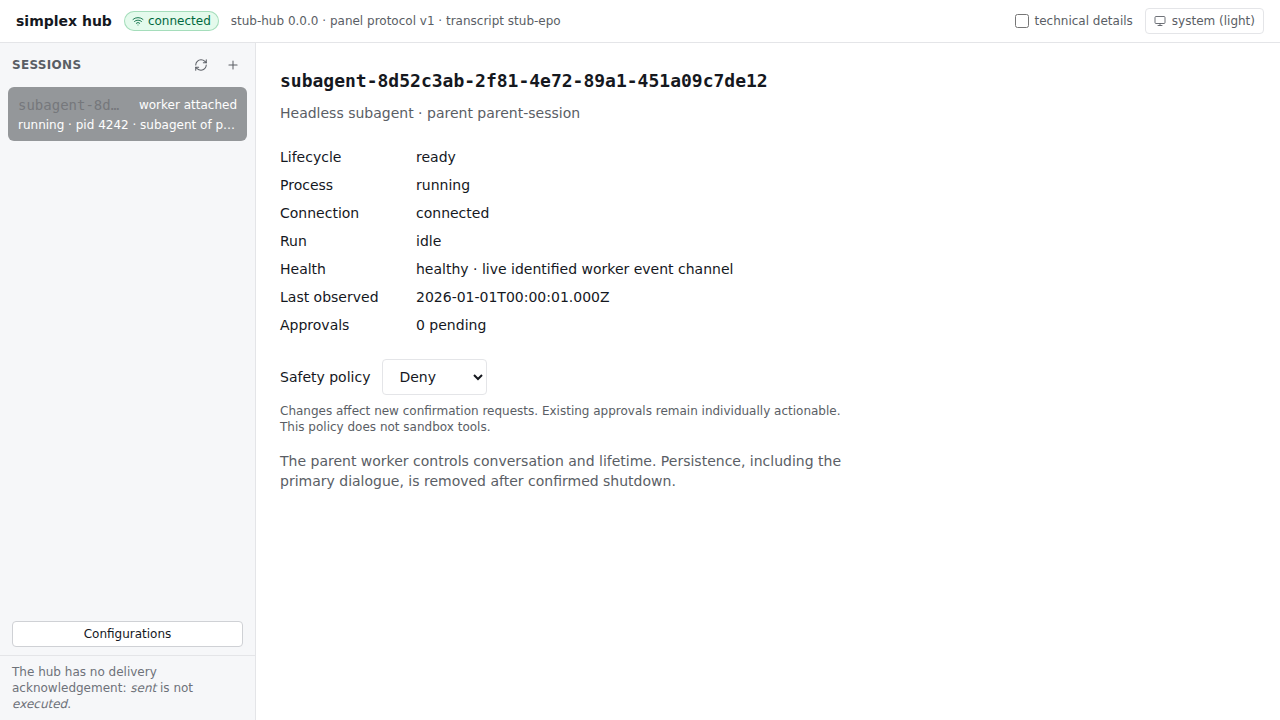
Health is an observation, not a watchdog for model progress. A live identified channel is healthy; disconnect/storage or protocol diagnostics are degraded; unverified/recovered/terminated workers are unknown. observed_at reports the last worker event. A long, quiet model request is not itself a health failure.
Clean-fork
subagent/clean-fork accepts an empty argument object. It reserves quota, creates private ownership/configuration files, commits a durable operation receipt, then schedules automatic startup. It returns immediately:
{"subagent_id":"subagent-12345678-1234-4123-8123-123456789abc","lifecycle":"preparing"}Read the child's state rather than assuming the process is connected. Lifecycle states are preparing, starting, ready, stopping, stopped and cleanup-pending. Failure reasons accompany status; startup failure/timeout initiates supervised shutdown and cleanup.
For legacy sessions the Hub captures config/startup-worker.yaml and config/startup-launch.jsonc for each supervised launch. Clean-fork uses that incarnation's startup snapshot, not the current configuration library or its public session description. It preserves providers/model roles, prompts, plugin admission/configuration, generation settings, explicit launcher environment and deployment options. Runtime payload options do not change the startup snapshot. The host environment continues to be inherited by the launcher; it is not copied into the snapshot.
The child receives fresh event/confirmation/remote-tool URLs and persistence root. Even if the parent disabled confirmation/remote tools, those channels are enabled for the child as lifecycle-owned overrides. Its relative state/memory directories remain unchanged; first startup uses restore: if_present. No parent state, memory, conversation, plan, event or process log is copied.
Supported relative workspace paths, plugin discovery directories, extension schema_directory/config_file, worker executable and launcher working directory retain their resolved meaning after relocation. Prompt files remain relative to the worker installation. Arbitrary plugin-specific path fields cannot be inferred; use absolute paths for additional external resources.
Managed launch profiles support local, SSH and retained-container Docker forks. The manager captures worker configuration on the target; Hub retains only the startup launch policy. Each child has a fresh flat target allocation, while its Hub bookkeeping remains in dataDir/subagents/. Remote worker paths need not exist on the Hub host. See managed family lifecycle for preparation, uncertain dispatch, recovery and cleanup. No shared Hub bind mount is required; the operator must retain the target/container until cleanup.
Supported launches are managed profiles (local, SSH and retained-container Docker) and supervised native simplex-worker executables. Daemonizing/PID-file launches and arbitrary wrapper commands are rejected as unsupported_launch. Extra native flags may not override config or session identity. Externally attached workers without a supervised startup snapshot cannot be forked.
This isolates identity and conversational persistence. Shared host workspace mounts/resources stay shared, and a managed Docker child shares its parent's retained-container filesystem: choose a distinct workspace path if children must not share one. Clean-fork provides no filesystem sandbox.
Remote routes
Use the existing dedicated tool listener and per-session token:
ws://<tools-host>:<tools-port>/agent/<caller>/tools/subagent/<operation>?token=<caller-token>The request/response envelope is unchanged. Echo worker_id, session_id, run_id, request_id; executable routes verify current connection, live worker, active run, lifecycle and direct-parent ownership. Independently delivered event admission can be held briefly, bounded by confirmIdentityHoldMs and the RPC socket deadline. Unknown routes continue to return not_implemented.
| Route | Arguments | Result |
|---|---|---|
subagent/clean-fork | {} | generated ID and initial lifecycle |
subagent/receive | {} | direct children, including retained terminal states |
subagent/receive | subagent_id, optional cursor (0), limit (5, range 1–10) | status, bounded request outcomes and current primary conversation page |
subagent/send | subagent_id, operation: message, content, optional options | child request ID and socket dispatch state |
subagent/send | subagent_id, operation: continue or compact, optional options | child request ID and dispatch state; content is forbidden |
subagent/send | subagent_id, operation: stop | operation ID and stopping state; content/options are forbidden |
All unspecified arguments are rejected. content follows normal worker payload content rules. This is the remote protocol, distinct from the C++ tool's text-only request argument: the tool sends exactly one {type: text, modality: text, raw: request} part and no extras. options.model and the empty reserved options.tools are accepted; options.confirmation is forbidden. The Hub always sends confirmation.mode: ask and applies the user's independent child policy at the confirmation boundary. Compact requires that child's current context-compact capability. Continue resumes worker state and creates no empty user turn. Stop is process shutdown with escalation, not cancellation of a single run. It immediately closes family admission and is idempotent.
Argument objects are limited to 64 KiB serialized UTF-8. Responses are limited to 256 KiB. Receive returns the latest 20 request outcomes, reducing that tail if needed (requests_truncated). Conversation cursors are offsets in the current bounded turn array; next/total describe that array, while each turn retains its worker index. A refresh/compaction can change the array/revision; restart cursor 0 to read a new revision. Oversized whole turns are omitted, the cursor advances, and truncated is true. Configuration, tokens, raw events, reasoning, tools and restorable AgentInputState are never returned.
Request outcomes distinguish intent, sent, admitted, rejected, unknown and finished. sent means socket queue admission only. finished carries the worker's run status; compact may include its published summary. Busy/invalid input is reported by the child's rejection. Connection loss before a definitive outcome produces unknown; it does not trigger retransmission. Receive is a snapshot query and never waits for a model run to finish.
Stable rejection codes include unauthorized, invalid_arguments, policy_forbidden, unsupported_launch, unsupported_operation, lifecycle_closed, disconnected, limit_exceeded, request_conflict, recovery_required, delivery_unknown, storage_error, result_too_large and not_implemented. Do not depend on diagnostic wording.
Duplicate requests and lost replies
Mutating subagent operations persist receipts keyed by caller lifecycle, worker, run and request IDs. Their canonical route/argument hash detects changed arguments or changed routes under the same key. Identical repeats within the retention window return the recorded commit result with replayed: true; receive gives the current status. Read-only receive has no receipt. Existing plan semantics remain unchanged.
Creation commits its ownership and receipt before launching. Send records intent and a retry receipt before writing the worker socket. A crash in between is unknown, even if the message never reached the worker. It is never replayed automatically. The send receipt conservatively retains unknown, even when the first reply reports sent; receive provides the subsequently observed outcome. Stop records its receipt before supervised work starts.
Before commit, deadline/disconnection prevents a queued operation from starting. After commit, a lost RPC peer does not roll back work; lifecycle work finishes under the supervisor. Use discovery/receive to recover a lost reply.
Receipts expire after receiptTtlMs or when maxReceipts newer receipts displace them. Request outcome tails are bounded to 200 entries and 512 KiB on disk. Duplicate suppression is bounded, not exactly-once execution. Do not reuse expired request IDs expecting deduplication.
Safety approvals
Each child begins with independent ask policy. Authenticated operators can select ask/deny/approve in the headless status view or send:
{"type":"subagent_policy","session":"subagent-12345678-1234-4123-8123-123456789abc","policy":"deny"}REST equivalent: POST /api/sessions/<id>/subagent-policy with {"policy":"deny"}. Worker models have no route to change this policy. Every mode requires a verified live worker and active run before answering a confirmation. Ask prompts are broadcast globally and labeled with child and parent. Deny/approve answer only newly verified requests; an existing ask prompt remains individually actionable after a policy change. Disconnection, expiry, stale identity and stopping never approve a request. Worker Trusted/DefaultDeny behavior is unchanged.
Persistence and lifetime
<dataDir>/sessions/<ordinary-id>/
<dataDir>/subagents/<generated-id>/
  metadata.json
  config/config.yaml
  config/launch.jsonc
  config/startup-worker.yaml
  config/startup-launch.jsonc
  state/                         # legacy only; managed state is on the target
  memory/                        # legacy only; managed archives are on the target
  conversation.json
  operations.json
  plan.json                      # if used
  logs/                          # bounded process stdout/stderr diagnostics
Children are flat, regardless of depth. Headless metadata is authoritative here; ordinary hub.json does not duplicate these records. Hub-owned metadata, receipts, conversation and configuration files use atomic replacement and mode 0600. Worker-written state/memory follow the launcher umask. Cleanup refuses linked roots/path escapes; it never recursively deletes a configured external workspace.
Headless events are consumed transiently for authorization, status and outcomes. There is no retained event ring, events.jsonl, ordinary replay/subscription or raw latest-envelope cache. Process stdout/stderr logs are separate, bounded operator diagnostics and can still contain sensitive output.
conversation.json stores committed user content and visible assistant content with turn/step association. It excludes reasoning, tool calls/results and extras. Live commits update it immediately; paginated worker history reconciles reconnects, restarts and event gaps when the worker is idle. Active runs do not start history queries on each model response. An in-flight refresh may finish validating its pages during a run, but a snapshot collected before a subsequent live commit or event gap cannot overwrite the live projection. The Hub retains the observed dialogue and catches up after run_finished, or after an idle status reveals a missed settlement. It does not merge pages from different revisions or guess canonical turn indices from an older snapshot. Refresh validates request/worker/ connection identity, both cursors, revision and ordering before publication; compact and connection changes cancel obsolete pagination. Each refresh discovers the history revision/count, then reads newest turns first, retaining an ordered tail rather than an old prefix. It keeps at most 32 final steps per turn, using the worker's omitted-step count to skip older fragments. Older turns and steps are evicted first when conversationBytes is reached; oversized visible text keeps a UTF-8-safe prefix. A refresh makes at most 64 page requests per attempt, with a three-second request deadline and at most three attempts per connection or run settlement. Model commits and repeated status polling cannot renew that retry budget. A queued refresh checks idleness again before sending; a failed refresh during a run waits for settlement rather than repeatedly restarting. After three unsuccessful attempts, the projection stays stale/incomplete until a new connection or settlement permits recovery. Page-budget exhaustion marks the projection incomplete/truncated. If the page limit interrupts an older turn, that unfinished turn is discarded and the fully validated newest tail is published. If the latest turn itself remains unfinished, or a revision/cursor validation fails, the refresh preserves the previously published results. The projection follows current worker history after compact, not an archival pre-compact chat log. It reports revision, worker_id, refreshed_at, stale, incomplete and truncated; worker history itself clips content, so recovery is not lossless. Live dialogue and child status are updated in memory immediately. Reconstructible conversation.json and event-observation metadata/list broadcasts are coalesced over a fixed 200 ms window; new events do not postpone its deadline. A Hub crash can lose that last window of projection updates; worker history remains the source of truth for recovering dialogue. Launch/ownership changes, stopping and recovery intent, operator policy changes, and changed operation receipts/outcomes remain synchronous atomic publications. Unrelated events do not rewrite an unchanged operation ledger that was successfully persisted. A failed ledger publication keeps its in-memory outcome marked as unpersisted, reports degraded child health, and is retried synchronously on subsequent events, even without a matching request ID. Only a successful write clears that marker; restart still treats durable unfinished delivery as unknown. These boundaries are internal and do not change tool delivery or approval authority.
Conversation-file publication failures preserve the previous durable file, mark the in-memory projection stale/incomplete, and report degraded child health without requiring another disk write. Timers and send failures cannot propagate storage errors out of the refresh worker. Deferred metadata failures also report degraded child health without requiring another successful write. Shutdown closes projection scheduling, cancels refresh/retry timers, and attempts the last pending conversation write before lifetime cleanup. The synchronous stopping metadata supersedes any queued observation; no delayed callback may recreate a deleted child directory. A failed flush never skips process termination or descendant cleanup. Projection writes still use synchronous file I/O, but bursts share fewer writes rather than one fsync per event.
Stopping/restarting/force-killing a parent, observing its process crash, or shutting down the Hub freezes all descendant admission synchronously and attempts every cleanup. Sibling failures do not skip later siblings. A mere WebSocket disconnect does not stop children. A worker incarnation change invalidates its old family.
Deletion waits for confirmed actual process termination and owned output pipes/log writer closure. Managed families additionally require target-side removal before deleting local bookkeeping. A managed Docker child uses the same docker exec transport and target policy as its parent; the Hub never inspects or signals the container. A docker exec CLI exit is only transport evidence, so a remote managed start remains unconfirmed until the manager reports that lifecycle idle and the dispatch journal records completion. If that evidence is lost, deletion stays blocked and the child remains cleanup-pending for operator intervention. Hub shutdown verifies the same journal for remote managed sessions instead of assuming that a lost transport ended the worker. Successful shutdown deletes all child persistence, including conversation. Parents must receive desired output first. Only small terminal status/outcome records remain in memory for one receipt TTL, capped at 128.
On restart the Hub restores processes and validates the parent graph/lifecycle before adopting a family. Previously ready children keep their lifecycle while awaiting reconnection; only unfinished startups receive a startup deadline. Stale parents, cycles and stopping intent trigger cleanup rather than resurrection. A crash between spawn and process publication can leave uncertain startup evidence: preserve it as cleanup-pending instead of deleting potentially live data. Missing records, unreadable process identity and failed transport probes never prove termination. A stored Linux PID/start-time incarnation that is confirmed absent or replaced can converge automatically; observing the recorded process/container stop also resolves an uncertain flag. Invalid ownership metadata is quarantined for operator inspection and blocks additional forks. Never delete such directories until the process/container is independently confirmed stopped. Owned output tasks have a five-second join deadline per cleanup attempt; an incomplete fence retains the directory rather than blocking sibling cleanup forever.
Bounded cleanup and operator recovery
Recoverable cleanup failures receive at most three automatic attempts, including the initial attempt, with ten- and twenty-second delays before subsequent attempts (checked every five seconds). Attempt counts are stored with ownership metadata, so restarting the Hub does not reset an exhausted budget or skip a pending backoff. Startup recovery of an ordinary parent's stop intent follows the same policy; each child is attempted at most once per automatic pass, including recursive work. Paused or deferred descendants are not rewritten by ancestor recovery. Unknown startup ownership pauses immediately after the initial stop attempt; repeating not-started is not useful evidence. Paused children remain cleanup-pending, consume quota, and expose an operator-recovery reason in the list, receive results and Hub warnings.
Use the authenticated operator JSON API to inspect a retained child:
curl -H "Authorization: Bearer $HUB_PANEL_TOKEN" \
  "$HUB_URL/api/sessions/$CHILD_ID/recovery"
The response includes lifecycle_id, uncertain_start, termination_confirmed, cleanup_attempts, max_cleanup_attempts, automatic_retry, retry_at and reason. It omits private tokens, launch arguments and environment. After fixing a temporary storage/daemon problem, submit retry with the returned lifecycle ID:
curl -H "Authorization: Bearer $HUB_PANEL_TOKEN" -H 'Content-Type: application/json' \
  -d '{"action":"retry","lifecycle_id":"<current lifecycle_id>"}' \
  "$HUB_URL/api/sessions/$CHILD_ID/recover"
retry grants a fresh bounded budget; it never declares an unknown process dead. For an unrecorded launch, independently locate and stop its worker/container first. Then use the same endpoint with action: "confirm-terminated". This action is an operator attestation that can delete the entire child directory, not a liveness probe. It is rejected if a recorded worker/container is known alive, an event connection is open, cleanup is in flight, or the lifecycle ID is stale. Unknown liveness is allowed only with this explicit attestation. The attestation is saved before cleanup; owned output fences and descendant cleanup still must finish. Worker tokens and remote tools cannot call this operator API. A successful cleanup releases quota and hides the child; 409 retains its data and reports the conflict or remaining cleanup failure. Invalid/quarantined metadata that cannot be restored still requires manual inspection/repair rather than this per-child endpoint. GET /api/subagents/recovery reports global {blocked, reason} when ownership metadata cannot be safely restored or the managed root cannot be enumerated. The Hub keeps serving, but new worker launches are blocked and new forks are rejected with recovery_required until the operator repairs the retained storage and restarts it. It never follows a linked subagents root to discover, overwrite or remove external data.
The operator-selected dataDir and any linked ancestors are canonicalized before managed paths are derived, including when the directory needs creation. Directory symlinks inside the managed sessions/subagents tree remain rejected for private state access and deletion; a failed safety check never removes its external target.
Resource configuration
The Hub JSONC configuration accepts:
{
  "subagents": {
    "maxLive": 16,
    "maxChildren": 4,
    "maxDepth": 3,
    "startupTimeoutMs": 30000,
    "maxReceipts": 200,
    "receiptTtlMs": 3600000,
    "conversationBytes": 1048576
  }
}
Reservations and cleanup-pending children count against capacity. Only confirmed resource removal releases quota. All limits are positive safe integers; conversationBytes must be at least 4096. Supported maxima are 128 live workers, 32 direct children, depth 16 and 1000 receipts. Keep deployment limits conservative: recursive delegation starts real processes/containers and shares configured credentials and external resources.
Complete child answers
Primary dialogue remains a bounded projection, but each supported committed response carries an answer_source referencing the child's canonical state. subagent_receive can supply answer: {source, part, offset} instead of a conversation cursor/limit to read exact 32 KiB UTF-8 pages. Start at part 0, offset 0; advance to next_part/next_offset, resetting offset when the part changes, and stop only on done. Copy all five source fields, including the required fingerprint. Incomplete sources are rejected before forwarding a Worker payload (invalid_arguments; the panel HTTP endpoint returns 400). Older sources without a fingerprint provide previews only. This works for text spread across multiple parts and avoids the normal tool-output presentation budget. Query authority is still limited to the caller's direct child and rechecked after the awaited page. The Hub does not cache an answer-sized assembly or expose filesystem paths.
Projection restoration retains sources for a still-live worker. A new worker incarnation requires fresh history sources; compaction and headless cleanup can expire them. Read a result before stopping its child. Older workers without answer-pages, missing sources and expired pages return explicit unavailability; a displayed prefix must not be treated as a complete task result.
Concurrent managed child preparation and cleanup share the Hub's target-namespace queue, including ordinary-session operations on the same namespace. Queue time counts toward the bounded management deadline and the child startup deadline. A stopped or expired child cannot launch after its queued preparation completes. Only unpublished manager busy refusals receive bounded retries; ambiguous transport outcomes retain their existing reconciliation behavior. Failed starts expose a sanitized management error category/code through child status, without including peer diagnostics, credentials or launch arguments.